other networks

  • about
  • weblog
  • articles & books
  • book club
  • events
  • recipes
  • contact
  • August 31, 2024

    artist talk on “Barbed Wire Telephone II” Tuesday Sept. 3rd 12pm Mountain Time

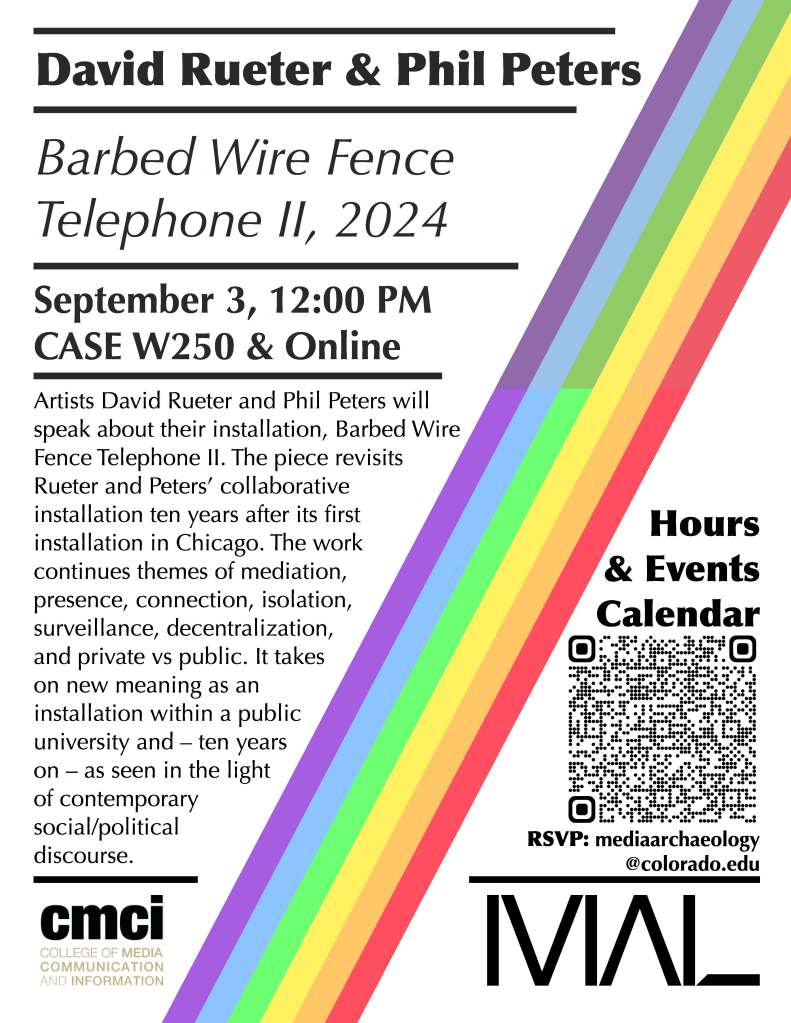
    The first official talk for the month of #OtherNetworks events around the “Barbed Wire Fence Telephone II” exhibition is a week from today! Join us Tuesday, Sept. 3 at 12 PM (MDT/UTC-6) for an artist talk from Phil Peters and David Rueter. This is a hybrid event: if you’re in Boulder you can join us on the CU campus in the CASE building room W250; or you can tune in virtually to our twitch channel or email <mediaarchaeology@colorado.edu> for a zoom link.
    About the work & the artists:

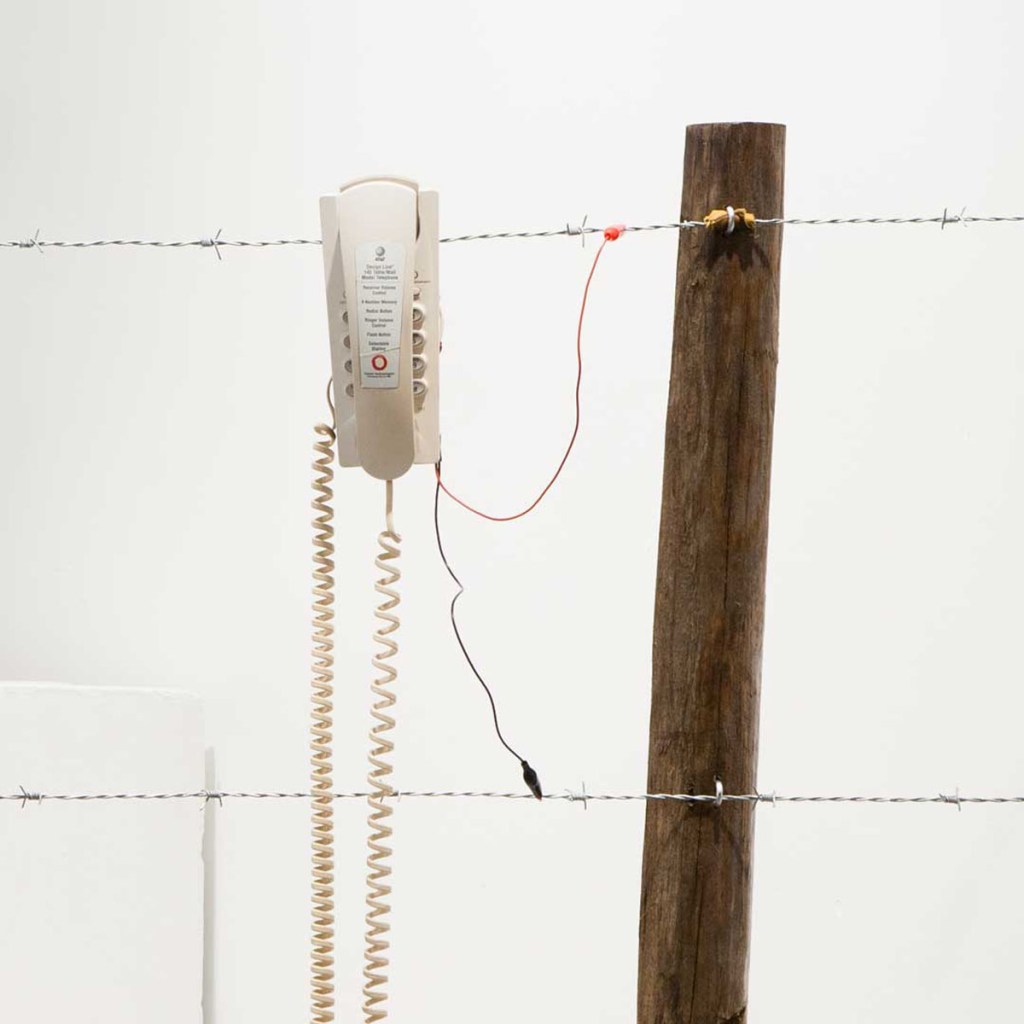
    Artists David Rueter and Phil Peters have created an incongruous social space: a barbed wire fence that bisects a university classroom. Two telephones hang on posts at either end of the fence, their wires clipped to the strands of barbed wire. Lifting the receiver, one can hear crackling analog signals pass along the fence line, the voice on the opposite phone both near and far, creating an interface that is at once a connection and a separation.

    The work takes inspiration from early communication networks of the turn of the twentieth century, when Bell Telephone Company began to connect cities across the United States. At this time, rural and western areas were mostly left out. Entrepreneurial ranchers discovered that ad-hoc, decentralized telephone networks could be built from simple materials at hand, transforming their pre-existing barbed wire fences into a network of transmission lines. 

    The piece revisits Rueter and Peters’ collaborative installation ten years after its first installation in Chicago. The work continues themes of mediation, presence, connection, isolation, surveillance, decentralization, and private vs public. It takes on new meaning as an installation within a public university and – ten years on – as seen in the light of contemporary social/political discourse.

    Phil Peters, born in 1981 (USA), lives and works in Los Angeles, CA. Peters’ transdisciplinary art practice explores the evolving relationship between the built and natural world through audio, video, and sculptural installations. Speculative architectural histories, contemporary ecology, and slippages between the biologic and geologic all inform this work. He received an MFA from the School of the Art Institute of Chicago, IL, and a BA from Carleton College in Northfield, MN. In 2014-15 he co-founded and curated an artist run project space LODGE (In Service of the Dark Arts), Chicago, IL. Exhibitions of his work include “Build Carry” at The Arts Club of Chicago’s Drawing Room, “Outside/In” at LAXART, Los Angeles, CA, “The Port of Long Beach Recordings” at The Canary Test, Los Angeles, CA, and “The Permian Recordings” at Co-Lab Projects, Austin, Tx.

    David Rueter, born in 1978 (USA), lives and works between Amsterdam, Netherlands and the United States. Rueter’s site-adapted videos, sculptures, and drawings often work with architectural or infrastructural elements hidden in plain sight. In circulation and serial production, each work accumulates and adjusts as it encounters institutional logics, frictional proximities, hearsay, and fragments of collective imagination. Rueter received an MFA from the School of the Art Institute of Chicago, IL, USA, and a BFA from Oberlin College, OH, USA. He has exhibited works made with longtime collaborator Marissa Lee Benedict (USA/NL, 1985) in such venues as: the 34th Bienal de São Paulo, BR / the 16th Venice Architecture Biennale, Venice, IT / The Museum of Contemporary Photography, Chicago, IL / Ditch Projects, Springfield, OR, USA / Jan Van Eyck Open Studios, Maastricht, NL / The Renaissance Society, Chicago, IL, USA / EXPO Chicago, Chicago IL, USA / Contemporary Art Brussels, Brussels, BE.
    events
  • August 20, 2024

    Build Your Own Mini FM Transmitter

    Our other networks for everyone booklet “Build Your Own Mini FM Transmitter” has been printed and we will be sending out hard copies to those who requested them very soon! If you were unable to request a physical copy, you can view or download the PDF here:

    FMTransmitterDownload

    Many many thanks to everyone for the outpouring of support for this project!

    Note: This is a corrected PDF. We made an error in editing and a 10pF ceramic capacitor (correct) was mistakenly listed as a 1µF ceramic capacitor (incorrect). If you have a printed copy, or have already downloaded a copy, the corrections are on pages 25, 41, 47 (two locations), and 48 (two locations). Many many apologies for the error! Find & replace is tricky!

    articles & books
    DIY, Mini FM Transmitter, other networks for everyone, OtherNetworks
  • August 2, 2024

    August Book Club Post!

    This month we’ll be reading Mar Hicks’ Programmed Inequality. As always, share your thoughts about your reading here or on our social media accounts using the #MALbookclub hashtag.

    ABOUT THE BOOK

    In 1944, Britain led the world in electronic computing. By 1974, the British computer industry was all but extinct. What happened in the intervening thirty years holds lessons for all postindustrial superpowers. As Britain struggled to use technology to retain its global power, the nation’s inability to manage its technical labor force derailed its transition into the information age.

    In Programmed Inequality, Mar Hicks explores the story of labor feminization and gendered technocracy that undercut British efforts to computerize. That failure sprang from the government’s systematic neglect of its largest trained technical workforce–simply because they were women. Women were a hidden engine of growth in high technology from World War II to the 1960s. As computing experienced a gender flip, becoming male-identified in the 1960s and 1970s, labor problems grew into structural ones and gender discrimination caused the nation’s largest computer user—the civil service and sprawling public sector—to make decisions that were disastrous for the British computer industry and the nation as a whole.

    Drawing on recently opened government files, personal interviews, and the archives of major British computer companies, Programmed Inequality takes aim at the fiction of technological meritocracy. With over 30 images–including period photographs and cartoons–the reader gets a feel not only for what happened, but the cultural texture of the time. Hicks explains why, even today, possessing technical skill is not enough to ensure women will rise to the top in science and technology fields. Programmed Inequality shows how the disappearance of women from the field had grave macroeconomic consequences for Britain, and why the United States risks repeating those errors in the twenty-first century.

    book club
    bookclub
  • August 2, 2024

    Barbed Wire Fence Telephone II

    This September, with the generous support of the College of Media, Communication and Information, we’re hosting an artwork titled “Barbed Wire Fence Telephone II”, conceived by Phil Peters and David Rueter. The work will be installed on the CU Boulder campus in CASE W250 for the entire month, with open house hours as often as we can manage.

    a fence post supports two strands of barbed wire. a telephone hangs from the top wire, and is connected by wires with alligator clips to both strands of wire.
    Image from the first installation of Barbed Wire Fence Telephone, 10 years ago

    Throughout the month of September in conjunction with that installation we’ll be hosting talks about the work and about community media, obscure networks, and self-governance from the artists themselves and scholars from CU and elsewhere. We’ll also be hosting a Snail Mail party and a closing social event. The full schedule of events is listed on this Google calendar and on the official CU events calendar, and we’ll be posting about everything through our social media accounts & on our website.

    The first official event will by an artist talk by Peters and Rueter on September 2 at 12pm (UTC-7) in CASE W250 and online. More details here.

    About the work & the artists:

    Artists David Rueter and Phil Peters have created an incongruous social space: a barbed wire fence that bisects a university classroom. Two telephones hang on posts at either end of the fence, their wires clipped to the strands of barbed wire. Lifting the receiver, one can hear crackling analog signals pass along the fence line, the voice on the opposite phone both near and far, creating an interface that is at once a connection and a separation.

    The work takes inspiration from early communication networks of the turn of the twentieth century, when Bell Telephone Company began to connect cities across the United States. At this time, rural and western areas were mostly left out. Entrepreneurial ranchers discovered that ad-hoc, decentralized telephone networks could be built from simple materials at hand, transforming their pre-existing barbed wire fences into a network of transmission lines. 

    The piece revisits Rueter and Peters’ collaborative installation ten years after its first installation in Chicago. The work continues themes of mediation, presence, connection, isolation, surveillance, decentralization, and private vs public. It takes on new meaning as an installation within a public university and – ten years on – as seen in the light of contemporary social/political discourse.

    Phil Peters, born in 1981 (USA), lives and works in Los Angeles, CA.

    Peters’ transdisciplinary art practice explores the evolving relationship between the built and natural world through audio, video, and sculptural installations. Speculative architectural histories, contemporary ecology, and slippages between the biologic and geologic all inform this work. He received an MFA from the School of the Art Institute of Chicago, IL, and a BA from Carleton College in Northfield, MN. In 2014-15 he co-founded and curated an artist run project space LODGE (In Service of the Dark Arts), Chicago, IL. Exhibitions of his work include “Build Carry” at The Arts Club of Chicago’s Drawing Room, “Outside/In” at LAXART, Los Angeles, CA, “The Port of Long Beach Recordings” at The Canary Test, Los Angeles, CA, and “The Permian Recordings” at Co-Lab Projects, Austin, Tx.

    David Rueter, born in 1978 (USA), lives and works between Amsterdam, Netherlands and the United States.

    Rueter’s site-adapted videos, sculptures, and drawings often work with architectural or infrastructural elements hidden in plain sight. In circulation and serial production, each work accumulates and adjusts as it encounters institutional logics, frictional proximities, hearsay, and fragments of collective imagination. Rueter received an MFA from the School of the Art Institute of Chicago, IL, USA, and a BFA from Oberlin College, OH, USA. He has exhibited works made with longtime collaborator Marissa Lee Benedict (USA/NL, 1985) in such venues as: 

    The 34th Bienal de São Paulo, BR / the 16th Venice Architecture Biennale, Venice, IT / The Museum of Contemporary Photography, Chicago, IL / Ditch Projects, Springfield, OR, USA / Jan Van Eyck Open Studios, Maastricht, NL / The Renaissance Society, Chicago, IL, USA / EXPO Chicago, Chicago IL, USA / Contemporary Art Brussels, Brussels, BE.

    events
    barbed wire fence telephone, history
Previous Page
1 2 3 4 5 … 8
Next Page


Loading Comments...
 

    • Subscribe Subscribed
      • other networks
      • Join 34 other subscribers
      • Already have a WordPress.com account? Log in now.
      • other networks
      • Subscribe Subscribed
      • Sign up
      • Log in
      • Report this content
      • View site in Reader
      • Manage subscriptions
      • Collapse this bar