other networks

  • about
  • weblog
  • articles & books
  • book club
  • events
  • recipes
  • contact
  • July 14, 2025

    exploring NABU in 2025, a Canadian cable TV network from 1984

    One of the networks Lori Emerson wrote about in Other Networks: A Radical Technology Sourcebook is the NABU Network (or the Natural Access to Bi-Directional Utilities Network). This was the only instance of a two-way network that operated over cable television. Users could rent or purchase a NABU Network PC, which used their home cable TV subscription to access NABU’s servers and, for a monthly fee, provided access to software and information. The computer could also function on its own, as it had a 80K capacity along with a sound generator and a graphics processor. The NABU servers were minicomputers called “head ends” whose digital output had to be modulated with an RF modulator before it could be transmitted over coaxial cable; the transmission then moved through what NABU called a “combiner,” a piece of equipment that merged NABU programs with the other information being transmitted over cable; the transmission subsequently moved through the “adaptor,” which was the interface between the cable and the user’s NABU PC, thereby making content appear on the user’s TV set.

    NABU Network service was first offered to select subscribers in Ottawa, Canada in the spring of 1982. One of the appeals of NABU was that its transmission speed was, according to one of its corporate pamphlets, over 21,000 times faster than the transmission rate over telephone lines. In fall 1983, it was announced in the trade publication Cable Marketing that NABU would extend its Ottawa service, which had access to 85,000 cable subscribers, to Richmond, Virginia and to Vancouver, Canada which had access to 250,000 cable subscribers. The extension was only one-way, with plans for two-way distribution; it is unclear whether two-way service was ever available to these extensions. In February 1984, it was announced in Cablevision that NABU was also extending to 5,000 cable subscribers in Alexandria, Virginia: “The Alexandria site was chosen, officials say, because of its proximity to Washington with the chance to show off the virtues of the network to officials in Congress, the NCTA [the National Cable & Telecommunications Association], the FCC and other important parties.” In December 1985, the publication The Hard Copy reported that NABU made an agreement with the Japanese firm ASCII that involved the installation of fifty NABU systems in select Japanese homes. In August 1986, NABU sent letters to its subscribers informing them that “Due to a low subscriber base and the ongoing problem of acquiring interesting and valuable software, we regret to inform you that THE NABU NETWORK will not be continuing its service beyond August 1986 . . . We hope you have benefited from your exposure to THE NABU NETWORK and that you will continue to pursue the benefits of computer technology.”

    According to a price list dated September 1984, it cost $19.95 CDN a month to rent the hardware and software with the option to add on entertainment, education, or home management software for anywhere from $4.95 to $7.95 a month, and another disk drive for $15.95 a month (adjusted for 2024, one would pay anywhere from $44 USD to over $100 USD a month). 

    Ex-FCC Chairman Tom Wheeler, who was president of NABU for its final year of service, wrote an editorial on net neutrality for Wired magazine in 2015 in which he used NABU as an example of what happens when networks are closed. For Wheeler, even though “NABU was delivering service at the then-blazing speed of 1.5 megabits per second,” which was hundreds of times faster than their competitor America Online, NABU folded because they “had to depend on cable television operators granting access to their systems,” whereas America Online “had access to an unlimited number of customers nationwide who only had to attach a modem to their phone line” to receive service. Simply put: “The phone network was open whereas the cable networks were closed.” However, Scott Wallsten responded to Wheeler’s editorial by pointing out that NABU failed not so much because it relied on a closed network, but because it could not provide enough meaningful resources to compel people to subscribe and also because cable infrastructure was not equipped to handle more than minimal two-way traffic.

    Beginning in December 2022, ex-NABU engineer Leo Blinkowski and DJ Sures, whose family members helped found NABU, launched the NABU Preservation Group (also known as RetroNET) as part of their now-successful attempt to develop a NABU Internet Adapter software. As they write on their website, “This software emulates the NABU Network Adapter, which would have been the hardware used to connect NABU Personal Computers to the NABU Network. The NABU Internet Adapter provides entertainment channels, such as the original NABU Network from 1984 and new homebrew software, demos and utilities.”

    In an incredible coincidence, a year later in 2023 the online magazine VICE reported that “2,200 Forgotten Vintage Computers Are Being Liberated From a Barn in Massachusetts.” The Media Archaeology Lab managed to purchase four brand new, unopened NABU computers from 1984 along with a NABU adaptor. It’s taken us awhile to find the time and space to experiment with the NABU RetroNet but here, finally, are some pictures of files we found while browsing the various iterations of the network from 1983 to 1986. While getting Rickrolled after trying to play NABU Doom was probably the highlight…

    black pixelated screenshot of Rick Astley dancing across a white background on a black Sony CRT

    …some of our other favorites were classified ads for computer rentals and whatever “THE CHURCH OF THE GREAT PROFIT PROSPER” is:

    screenshot of a classified ad for "COMPUSPORTS" which appears to be a computer rental company
    screenshot of a NABU screen designed to look like a page of classified ads from the newspaper. reads "NEWS FLASH / CLASSIFIED ADS ARE HERE!"

    And for some reason we have a penchant for this computer glossary that gives us mid-80s definitions of network, telex, telidon, time share, “electronic mail,” and even artificial intelligence:

    glossary definitions of network, off-line, and on-line
    glossary definitions of teleconferencing, teletext, and teletype
    glossary definitions of telex, telidon, terminal, text editor
    glossary definitions of time-share and turtle graphics
    glossary definitions of drive, duplex channel, electronic mail, error rate
    glossary definitions of artificial intelligence, ASCI, and asynchronous

    Sources: “NABU PC Technical Specifications,” Spec. 50-90020490, nabunetwork.com; “Nabu Comes On Line,” Cable Marketing 3:9 (October 1983); “Heading South for the Market,” Cablevision (February 6, 1984); NABU letter to customers, dated February 6, 1984, York University Computer Museum NABU archives; “Price List and Subscription Rates,” York University Computer Museum NABU archives (The NABU Network, September 1984); The Hard Copy 1:1 (undated), York University Computer Museum NABU archives; Tom Wheeler, “This Is How We Will Ensure Net Neutrality,” Wired magazine (February 2015); Scott Wallsten, “The NABU Network: A Great Lesson, But Not About Openness,” The Technology Policy Institute website (February 5, 2015); “About RetroNet,” Nabu.ca website

    One of the networks I wrote about in Other Networks: A Radical Technology Sourcebook is the NABU Network (or the Natural Access to Bi-Directional Utilities Network). This was the only instance of a two-way network that operated over cable television. Users could rent or purchase a NABU Network PC, which used their home cable TV subscription to access NABU’s servers and, for a monthly fee, provided access to software and information. The computer could also function on its own, as it had a 80K capacity along with a sound generator and a graphics processor. The NABU servers were minicomputers called “head ends” whose digital output had to be modulated with an RF modulator before it could be transmitted over coaxial cable; the transmission then moved through what NABU called a “combiner,” a piece of equipment that merged NABU programs with the other information being transmitted over cable; the transmission subsequently moved through the “adaptor,” which was the interface between the cable and the user’s NABU PC, thereby making content appear on the user’s TV set. 
    book club
  • June 3, 2025

    fundraising for Media Before Media exhibit

    Our big news for the summer…

    It’s a shame that “we are excited to announce” has become such an online cliché – especially since we are actually excited that the pop-up space for the Media Archaeology Lab (in CASE W250 on the CU Boulder campus) will be shifting from the “Other Networks” exhibit we curated for spring semester to a new exhibit titled “Media Before Media” for fall semester! This exhibit will still include some other networks like radio and telegraph and it will also explore a wide range of early devices including mechanical calculators, robot toys and automata, pre-cinema visual toys, early computational art making devices, past examples of attempts at artificial intelligence, and more.

    To help facilitate the purchase of some new devices for the exhibit, we’re running a small fundraiser. Some of the pieces we’re hoping to purchase include: a wind-up automaton, a magnetic wire recorder, wire recordings and blank wire, a stereoscope viewer, and a miniature phenakistiscope. If you’d like to contribute to the fund we’re using to purchase, you can do so through our paypal pool. We’ll be putting together a little thank-you pack including stickers and limited-edition postcards of images from the MAL collection for donations over $15, so please make sure to include a good contact email address so we can reach out to you for shipping info.

    events
  • February 22, 2025

    Other Networks is now available for pre-order

    At long last, Lori Emerson’s OTHER NETWORKS: A RADICAL TECHNOLOGY SOURCEBOOK is officially available from Anthology Editions for pre-order! This book is an archival project that catalogs 80+ networks that preceded or existed outside of the internet. It is also an educational project that comes out of Emerson’s belief that we are all capable both of understanding networks from the past and of building alternative networks for the future; a love letter to experimental art and technology; and a liberatory guide for escaping the corporate present–all wrapped up in the most beautiful design. Both the cover design and interior design brilliantly both recall the long history of telecommunications networks (exemplified by late 19th century/early 20th century telegraph and telephone manuals) and rewrites that same history to now have a more global perspective and to include more women; Black, Indigenous, and People of Color; and artist experiments with/on these pre-internet networks.

    Below is the table of contents. Emerson has also posted on her blog excerpts from or expanded versions of entries on microbroadcasting, barbed wire fence phones, and imaginary networks.

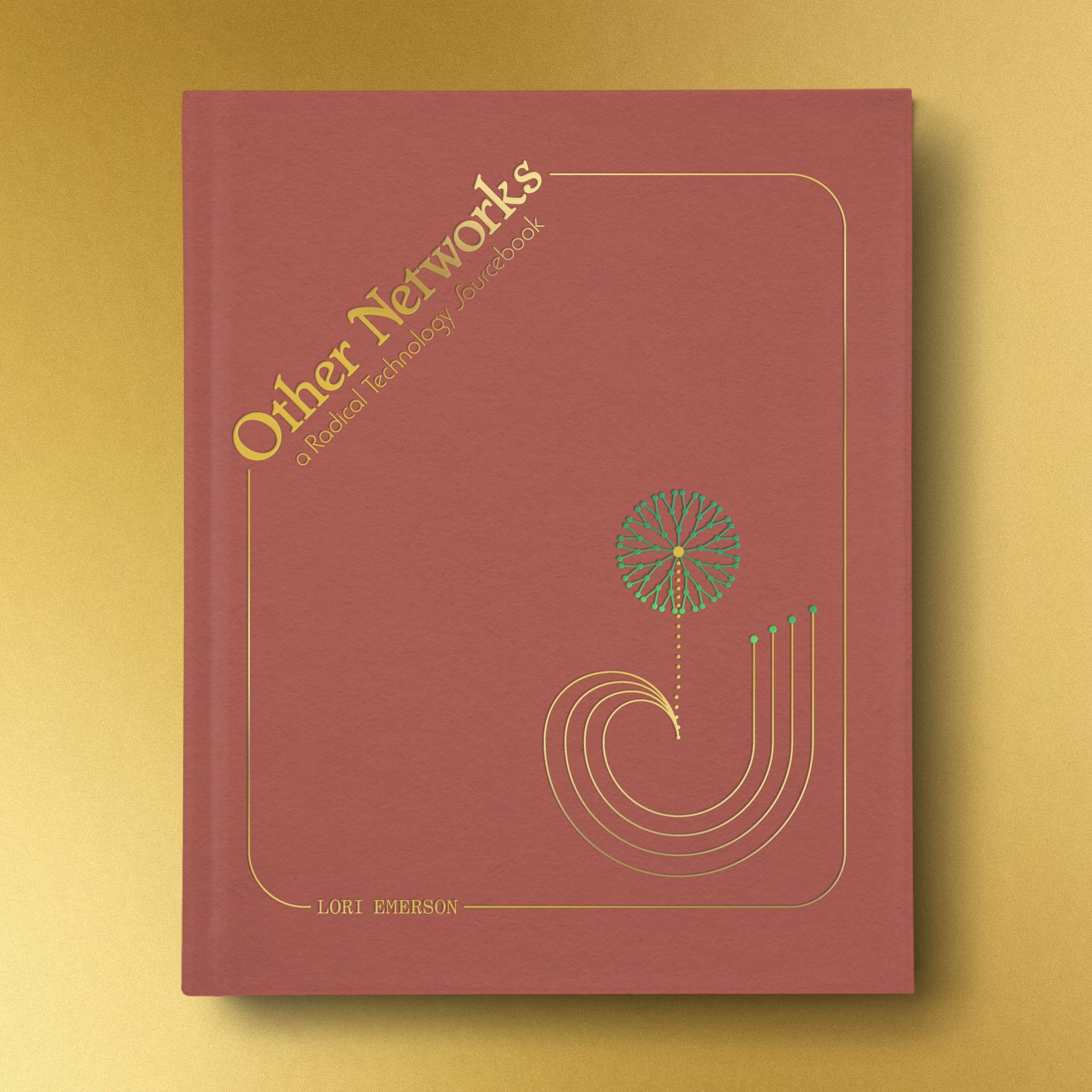
    book rests on a yellow surface. cover is muted, dusty pink fabric with text in gold foil. a rectangle with rounded edges wraps around the inside perimeter of the cover. "Other Networks: A Radical Technology Sourcebook" appears diagonally along the top left corner. "Lori Emerson" appears in gold foil on the bottom left corner. the bottom right corner features an image that is of an imaginary network topology. the top of the image is similar to a dandelion in green foil. a gold dotted line emerges from the flower and turns into four gold lines that curve around and terminate in four green foil dots
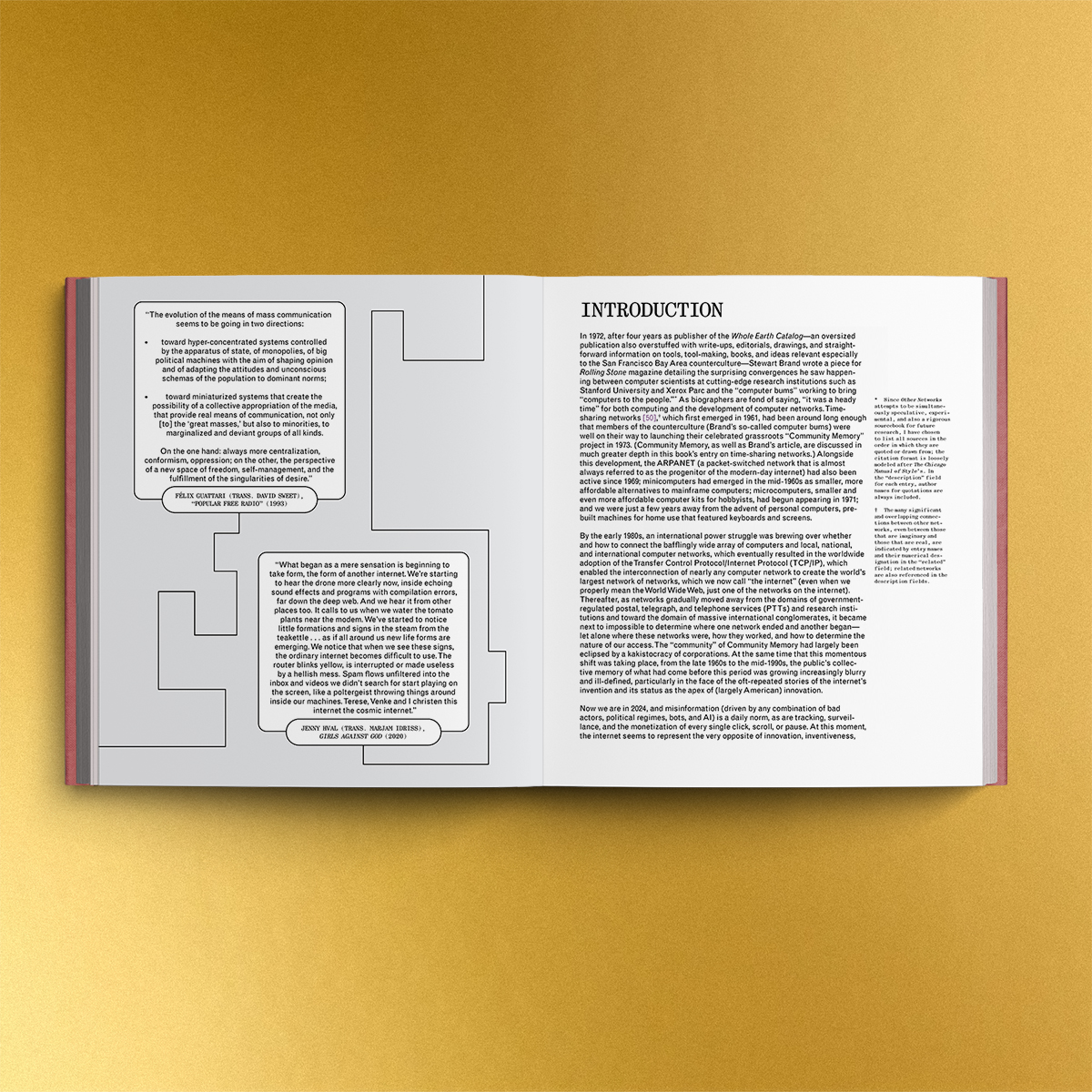
    yellow background. book spread open with two cut-out quotes in black boxes with straight black lines emerging from each quote on the left side of the open book. on the right is the first page of the introduction.
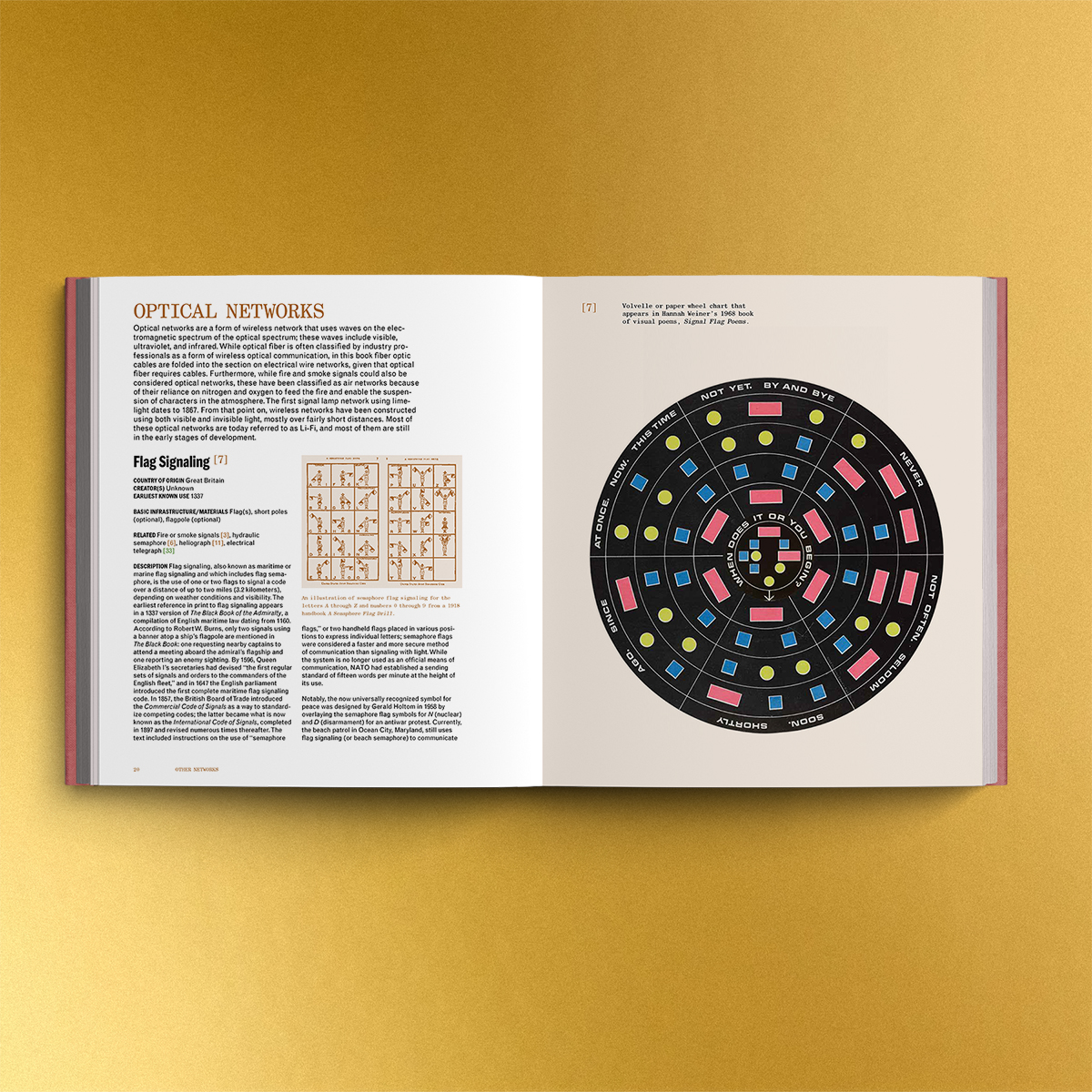
    yellow background. book open to a page on the left with a heading in brown type, "OPTICAL NETWORKS" and a sub-section labeled "Flag Signaling". the image on the right side of the page is from Hannah Weiner's Signal Flag Poems.
    yellow background. book spread open with a black and white photograph spanning both pages that shows Bill Bartlett and others experimenting with slow scan t equipment. overlaid on the photograph is a diagram showing how the group set up and conected their slow scan equipment.
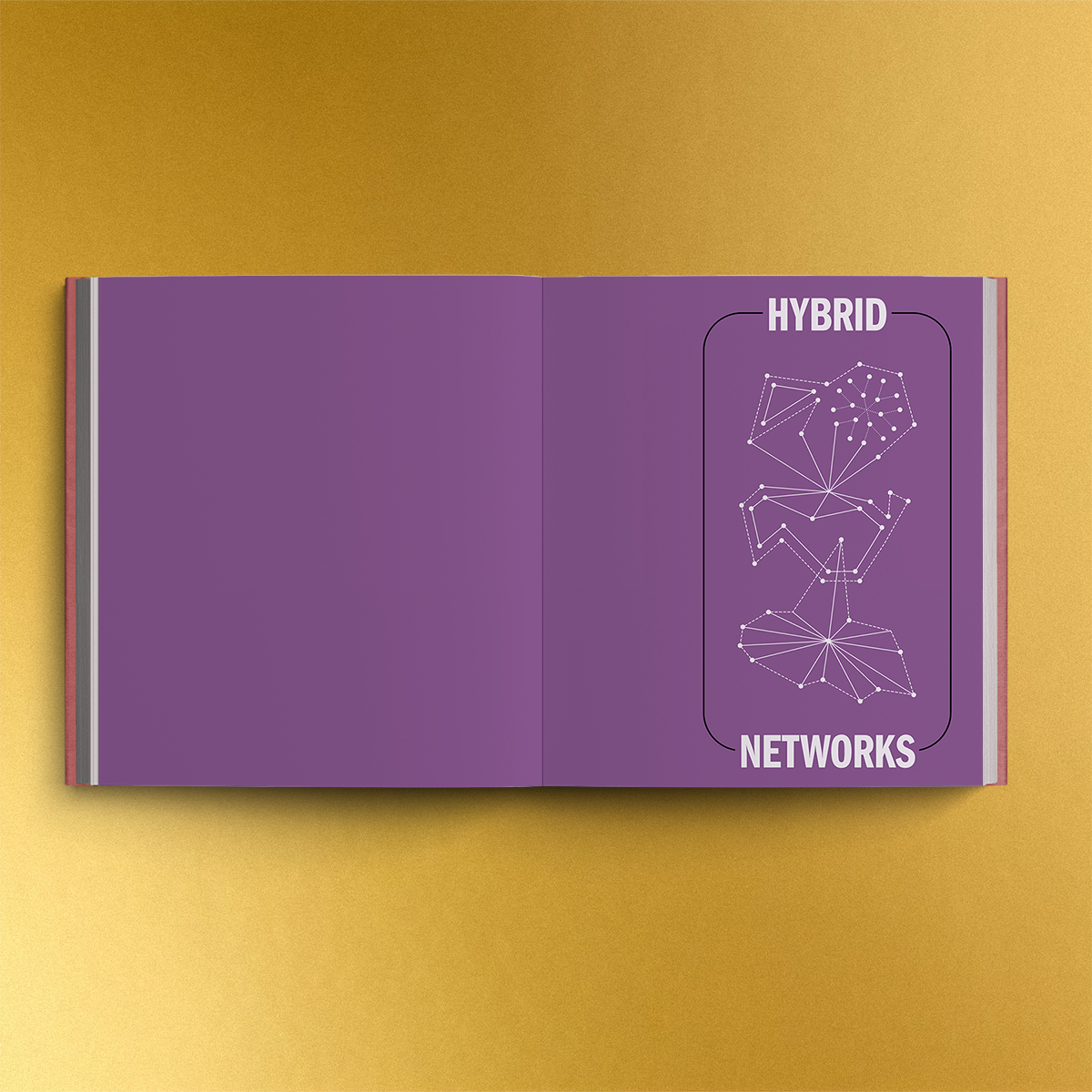
    two-page spread of interior section design for "Hybrid Networks." purple background and white text. the page on the right side has "HYBRID" at the top, an image of two different network topologies intersection with each other, and the word "NETWORKS" at the bottom
    yellow background. book spread open to display a black and white photograph spanning both pages of a bookmobile in Charleston County from 1946. a white middle-aged woman sits at a table. she is surrounded by 10 African American girls, boys, and young women, many of whom are holding books and reading.

    Chronological List of Networks
    Chronological List of Network Experiments
    Acknowledgements
    Foreword
    Introduction

    Wireless Networks:
    Sound Networks
    [1] Drums
    [2] Whistling

    Air Networks
    [3] Fire or Smoke Signals
    [4] Pneumatic Tubes
    [5] Skywriting

    Water Networks
    [6] Hydraulic Semaphore

    Optical Networks
    [7] Flag Signaling
    [8] Optical Telegraph
    [9] Infrared Communication
    [10] Signal Lamp
    [11] Heliograph
    [12] Photophone
    [13] Ultraviolet Communication
    [14] Laser Communication
    [15] Visible Light Communication

    Radio Networks
    [16] Amateur Radio
    [16.1] Radiotelegraphy
    [16.2] Radioteletype
    [16.3] Amateur Television
    [16.4] Hellschreiber
    [16.5] Earth-Moon-Earth Communication
    [16.6] Amateur Radio Satellite
    [16.7] Amateur Packet Radio
    [17] Radio Broadcast
    [18] Pirate Radio
    [19] Radiofax
    [20] Two-Way Radio
    [21] Pager
    [22] Meteor Burst Communication
    [23] Slow Scan Television
    [24] Project West Ford
    [25] Pirate Television
    [26] Packet Radio Network
    [27] Microbroadcast
    [28] Software Defined Radio
    [29] Wi-Fi
    [30] Bluetooth

    Microwave Networks
    [31] Microwave Radio-Relay
    [32] Communications Satellite

    Wired Networks:
    Electrical Wire Networks
    [33] Electrical telegraph
    [33.1] Electrical Printing Telegraph
    [33.2] Image Telegraph
    [33.3] Fire Alarm Telegraph
    [33.4] Pantelegraph
    [33.5] Telephonic Telegraph
    [34] Telephone
    [35] Wired Radio
    [36] Telautograph
    [37] Telefacsimile
    [38] Videophone
    [39] Telex

    Barbed Wire Networks
    [40] Barbed Wire Telegraph
    [41] Fence Phones

    Hybrid Networks:
    [42] Library
    [43] Book
    [44] Postal System
    [44.1] Pigeon Post
    [44.2] Projectile Post
    [44.3] Balloon Mail
    [44.4] Pony Express
    [44.5] Airgraph and V-Mail
    [44.6] Email Letter
    [45] Sneakernet
    [46] Radio Broadcast Network
    [47] Broadcast Television
    [48] Cable Television
    [48.1] NABU
    [49] Cellular Network
    [50] Time-Sharing Network
    [51] Teletext
    [52] Videotex

    Imaginary Networks:
    [53] Necromancy
    [54] Pasilalinic-Sympathetic Compass
    [55] Telephonoscope
    [56] Telepathy
    [57] Ley Lines
    [58] Mundaneum
    [59] World Brain
    [60] Memex
    [61] Faster-Than-Light Communication Networks
    [62] Project Xanadu
    [63] Metaverse
    [64] The Clacks
    [65] Pandoran Neural Network
    [66] Cosmic Internet

    articles & books
  • February 13, 2025

    Open Social Skillshare!

    On Friday, Feb. 14, 2025, we host(ed) a skillshare session around open social media. This post will be updated post-facto with relevant documentation on the session, but for now here are some pertinent links:

    Ethical Alternatives:
    https://alternativeto.net/
    https://ethical.net/resources/
    https://european-alternatives.eu/

    Alternative Social Media Platforms:
    What is Mastodon?
    A beginner’s guide to Mastodon
    A beginner’s guide to Bluesky
    What is Bluesky?

    “Migration” Tools:
    https://openportability.org/en/auth/signin

    Some notes post-session:

    Attendees included a good mix of conventional social media users, alternative social media users, and abstainers.

    Conventional social media users expressed concerns over:

    • losing contact with friends and family
    • not keeping up with general social trends and memes / feeling irrelevant
    • lacking information necessary to switch to a platform that meets their needs and wants.
    • inability to engage in day-to-day activities in non-US countries (i.e. whatsapp being de-facto required for student life in some european countries, business access being tied to whatsapp in many parts of the world)

    Ultimately, 3 participants decided to join some form of alternative social media – 2 bluesky, 1 mastodon.

    • bluesky adopters chose this option because of the existing academic and other communities on bluesky (#blacksky, etc.)
    • curation and moderation tools were also a consideration for choosing bluesky
    • the mastodon adopter chose this option because they were already invited to an existing server and so had overcome the server-choice hurdle. they were not able to set up an account as the server they chose required an application and approval process, but they did begin this process.

    book club
1 2 3 … 8
Next Page


Loading Comments...
 

    • Subscribe Subscribed
      • other networks
      • Join 34 other subscribers
      • Already have a WordPress.com account? Log in now.
      • other networks
      • Subscribe Subscribed
      • Sign up
      • Log in
      • Report this content
      • View site in Reader
      • Manage subscriptions
      • Collapse this bar