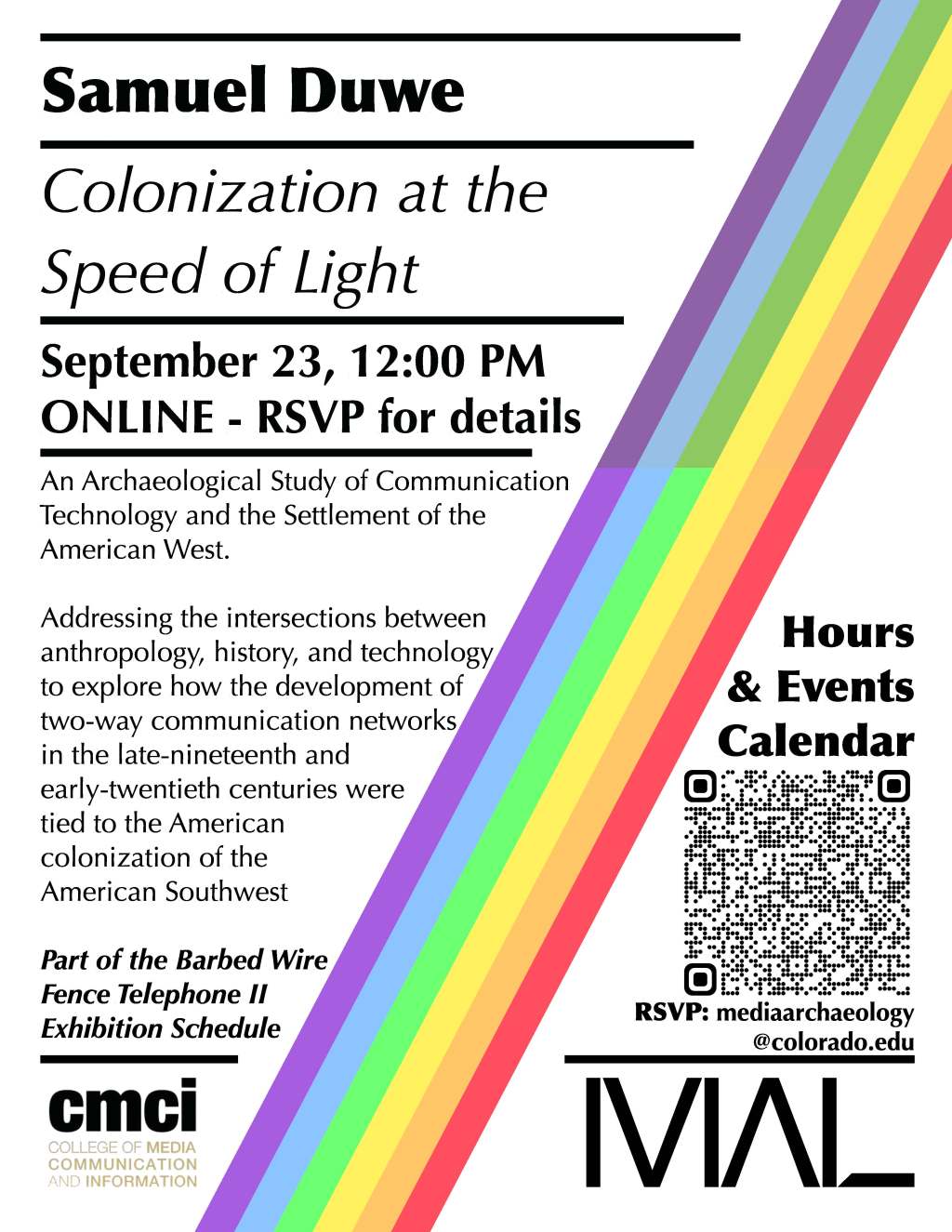
We have one last talk related to the “Barbed Wire Fence Telephone II” installation, coming up on Monday Sept. 23rd at 12pm on Twitch/Zoom.
Who: Professor Samuel Duwe
What: “Colonization at the Speed of Light: An Archaeological Study of Communication Technology and the Settlement of the American West”
When: 12pm MT
Where: Streaming on Twitch
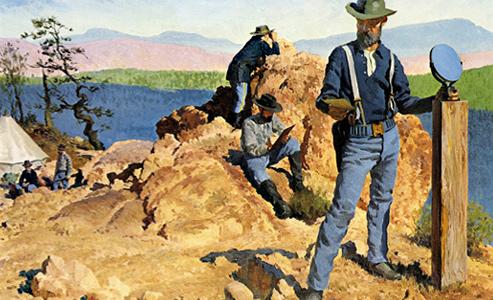
This talk addresses the intersections between anthropology, history, and technology to explore how the development of two-way communication networks in the late-nineteenth and early-twentieth centuries were tied to the American colonization of the American Southwest. While this takes many forms (railroads/telegraph, telephones, radio), I specifically focus here on one brief but dramatic event: the Geronimo Campaign of 1886. I am currently examining the network of heliographs (sun-mirror signaling) employed by the U.S. Army in southeastern Arizona to aid in capturing the Apache leader. Through a synthesis of archaeological material, archival records, and GIS analysis I seek to virtually reconstruct this network to address its debated effectiveness in warfare as well as begin to broach how the Apache conceptualized, responded, and adapted to a novel network of surveillance.
Samuel Duwe is an Associate Professor in Anthropology at the University of Oklahoma. He is broadly interested in integrating archaeology, oral history, ethnography, and historical documents to understand the development of worldview and society, particularly during colonial encounters. In addition to work on American colonialism he has spent two decades working for and with Pueblo communities to document dynamic histories of adaptation and survivance.
We would love to see you on the screen and please feel free to share with anyone you think might be interested.
 other networks
Leave a comment